
Noem v. Vasquez Perdomo opens the door to a Two-Tiered System of Belonging
Some Supreme Court decisions settle law in ways that bring us closer to the ideals enshrined in the Constitution. Others legitimize existing hierarchies of power. Noem v. Vasquez Perdomo paves the way for the latter by making it easier for ICE to justify immigration stops based on factors that appear neutral but are inseparable from race. Put bluntly, it opens the door to racial profiling becoming a judicially sanctioned feature of our immigration enforcement system.
On Sept. 8, 2025, the Supreme Court opened that door when it stayed a lower court’s restraining order and allowed immigration agents, for now, to continue detaining and seizing people based on proxies tied to race: appearance, language or accent, location, and type of work.
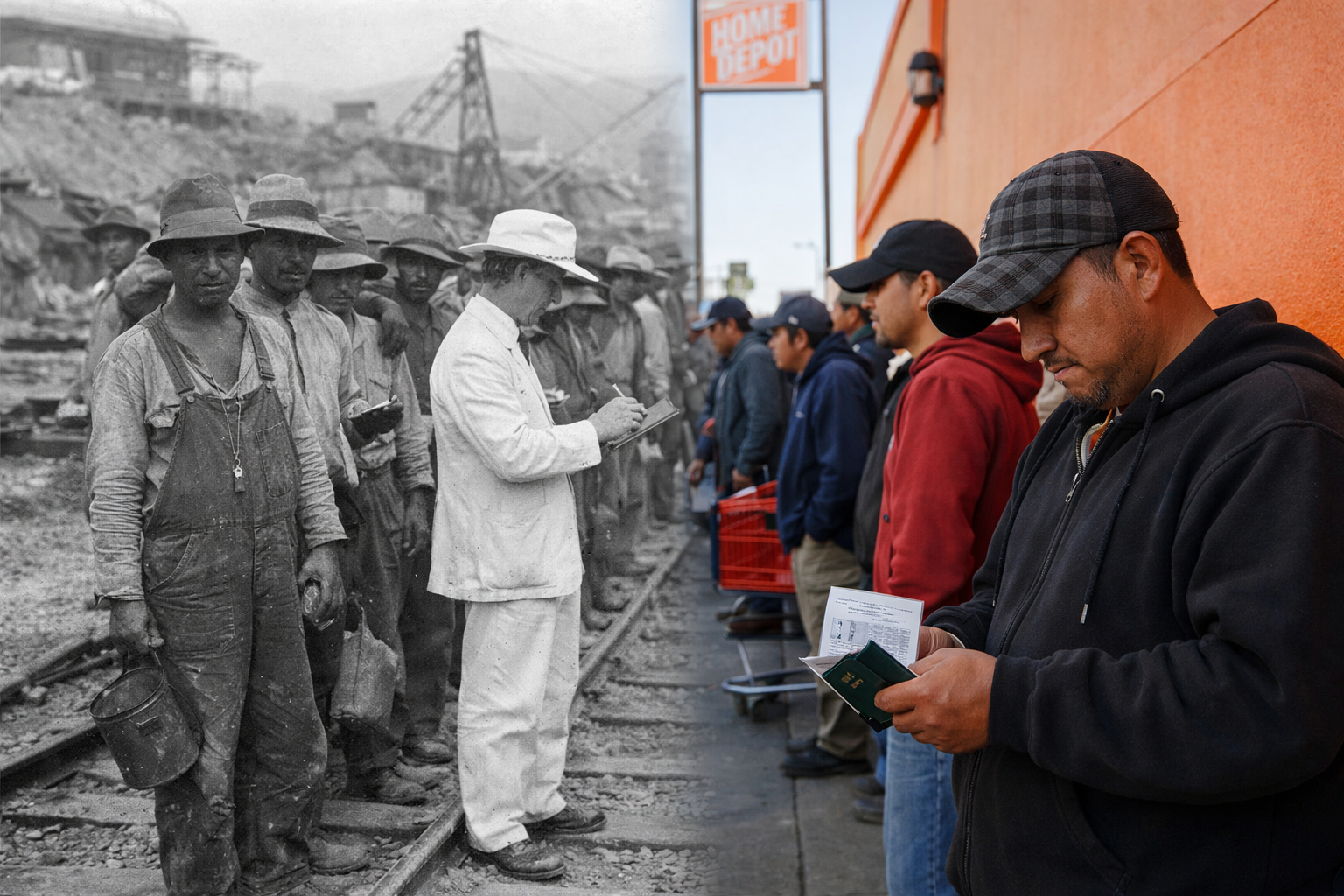
In his classic Poema de amor, poet Roque Dalton paid tribute to the Salvadoran immigrants who, like other Latin American and Caribbean workers, helped build the Panama Canal and were classified on the “silver roll” rather than the “gold roll.”
Under the U.S.-run labor system in the Panama Canal Zone, workers were sorted into a two-tier hierarchy. One group, the Gold Roll, was paid more, housed better, and treated as though it had earned its place. The other, the Silver Roll, was paid less, housed worse, and treated as though it should be grateful for whatever it got and not complain. The classification system sounded administrative, neutral, based on merit. But in practice, those supposedly neutral criteria operated as proxies for race, making “merit” a way of laundering racial hierarchy into the system.
The U.S. Supreme Court’s decision in Noem threatens to smuggle a similar racialized hierarchy of belonging into American life, including for U.S. citizens, by creating the conditions for a two-tier system of gold roll citizenship and silver roll citizenship. In her scathing dissent, Justice Sonia Sotomayor argued that the Court, on its emergency docket and without full explanation, blessed a regime under which the government may seize people based on proxies functionally inseparable from race.
Her core critique is devastating, especially coming from a former prosecutor: the Constitution requires that the government bear the burden of justifying suspicion. But Justice Kavanaugh’s concurrence shifts that burden onto people marked by traits that operate as proxies for race. Those who look Latino, speak Spanish or accented English, and work low-wage jobs may now have to move through public life prepared to prove they have a legal right to belong.
As Justice Sotomayor put it, “The concurrence improperly shifts the burden onto an entire class of citizens” to prove they are entitled to move freely. She warns that this creates something perilously close to second-tier citizenship, in which constitutional freedom is presumptive for one class of people and conditional for another. In her words, “The Constitution does not permit the creation of such a second-class citizenship status.”
Formally, what Noem opens the door to is not segregation. No statute says Latino citizens must carry papers. No opinion announces that one ancestry group has fewer rights than another.
But in operation, the message is unmistakable: some Americans may move through public space as presumptively belonging, while others must live prepared to prove it.
4th Amendment to the U.S. Constitution
The right of the people to be secure in their persons, houses, papers, and effects, against unreasonable searches and seizures, shall not be violated, and no Warrants shall issue, but upon probable cause, supported by Oath or affirmation, and particularly describing the place to be searched, and the persons or things to be seized.
The dissent, authored by Justice Sotomayor and signed by Justices Kagan and Brown Jackson, summarized the danger bluntly:
“The Fourth Amendment protects every individual’s constitutional right to be “free from arbitrary interference by law officers.” Brignoni-Ponce, 422 U. S., at 878. After today, that may no longer be true for those who happen to look a certain way, speak a certain way, and appear to work a certain type of legitimate job that pays very little. Because this is unconscionably irreconcilable with our Nation’s constitutional guarantees, I dissent.”
That is the danger.
Equal citizenship can be hollowed out long before it is formally denied. A government does not need to announce a racial hierarchy to reproduce one through ostensibly neutral markers, such as employment, location, language/accent, and appearance that are oftentimes inextricably linked to racial groups.
Once those markers are allowed to stand in for suspicion, citizenship begins to split in practice. For some, it remains a presumption. For others, it becomes something to defend.
Unfortunately, the Court’s decision in Noem makes easier an old American alchemy: turning equal citizenship into gold roll citizenship for some and silver roll citizenship for others.
Wherever language or accent can operate as a proxy for ancestry, work as a proxy for race, and location as a proxy for ethnicity, racial hierarchy can be rebuilt without ever admitting its name.
That makes this about more than immigration enforcement.
It is about whether constitutional equality still restrains power in any meaningful way. A nation aspiring toward the full promise of democracy cannot claim to reject caste, while teaching part of its population to move through public space as though its belonging is contingent on proof and innocence requires documentation.
The Constitution should not be interpreted, as it has been in the past, to permit two kinds of citizenship: one in which some Americans live under the ordinary presumption of belonging, while others are forced to stay ready to prove it. It should not be read to permit a gold roll America and a silver roll America.
The task now is to stop those trying to turn that hierarchy into law, in the courts, in the streets and online, and at the ballot box.
 Hector Perla.com